

Cloud Computing · November 17, 2026
What If Your Machines Could Warn You Before They Break?
How IoT, Predictive Analytics, and Smart Monitoring Are Changing the Future of Industrial Maintenance
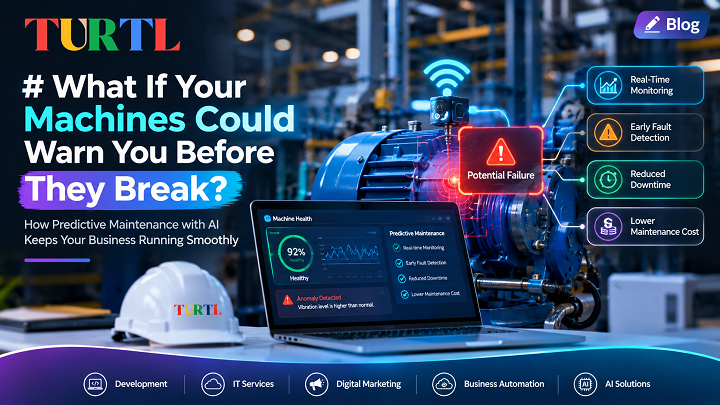
Imagine a manufacturing facility operating at full capacity.
Production is running smoothly, customer orders are scheduled, and employees are working toward an important delivery deadline.
Suddenly, a critical machine stops functioning.
Operations slow down. Maintenance teams begin troubleshooting. Replacement components must be arranged, and production schedules are disrupted.
The financial impact may include lost output, emergency repair expenses, overtime, and delayed deliveries.
Now imagine a different situation.
Several days before the failure, connected sensors identify unusual vibration patterns and rising equipment temperatures.
A monitoring system alerts the maintenance team, allowing technicians to investigate during a planned maintenance window.
This is the potential of IoT-enabled predictive maintenance.
Instead of relying entirely on fixed maintenance schedules or waiting for equipment to fail, businesses can use operational data to identify emerging problems and make more informed maintenance decisions.
1. What Is IoT Predictive Maintenance?
The Internet of Things, commonly called IoT, connects physical devices to digital systems so they can collect and exchange information.
In industrial environments, these devices may include sensors installed on motors, pumps, compressors, production machinery, and other operational equipment.
Sensors can measure indicators such as:
- Temperature.
- Vibration.
- Pressure.
- Electrical current.
- Equipment operating hours.
- Energy consumption.
- Acoustic signals.
- Environmental conditions.
This information can be collected continuously or at defined intervals and analyzed to identify patterns associated with equipment health.
Predictive maintenance uses this information, often combined with statistical methods or machine learning, to estimate when maintenance may be necessary.
The purpose is to improve maintenance planning and reduce avoidable disruption.
2. Traditional Maintenance vs Predictive Maintenance
Businesses commonly use three maintenance approaches.
Reactive Maintenance
Equipment is repaired after a failure occurs.
This approach may be suitable for inexpensive, non-critical components, but failures involving critical equipment can cause expensive disruptions.
Preventive Maintenance
Maintenance activities are scheduled according to time or operating hours.
For example, a machine may be serviced every three months regardless of its actual condition.
This approach is structured and often effective, but some maintenance may occur earlier or later than necessary.
Predictive Maintenance
Maintenance decisions are informed by operating conditions and equipment data.
A monitoring system may detect changes that suggest a component requires inspection.
Predictive maintenance does not eliminate failures, but it may improve the timing of maintenance interventions.
3. How Does Predictive Maintenance Work?
A typical system combines physical monitoring devices, secure connectivity, data processing, analytics, and maintenance workflows.
Step 1: Collect Equipment Data
Sensors capture measurements from machines and industrial equipment.
The required sensor type depends on the failure modes being investigated.
For example, vibration monitoring may be useful for rotating equipment, while temperature monitoring may help identify overheating.
Step 2: Transfer Information Securely
Sensor data is transmitted through appropriate industrial communication networks, gateways, or secure internet connections.
For certain environments, edge computing allows data to be processed near the equipment without continuously transmitting every measurement to the cloud.
Step 3: Analyze Patterns
Analytics software evaluates equipment readings against expected behavior.
More advanced systems may use machine learning to identify anomalous patterns or estimate the remaining useful life of specific components.
Step 4: Generate Maintenance Alerts
When readings exceed relevant thresholds or patterns suggest a problem, the monitoring system can notify maintenance personnel.
Alerts should include sufficient context to support an investigation rather than simply reporting that something is wrong.
Step 5: Take Corrective Action
Maintenance teams inspect the equipment, verify the issue, and schedule appropriate work.
The results of these interventions can help improve future monitoring rules and model performance.
4. Business Benefits of IoT-Enabled Maintenance
Reduced Unexpected Downtime
Early identification of equipment deterioration may allow repairs to be scheduled before complete failure.
This can reduce disruptions in suitable industrial environments.
Better Maintenance Planning
Teams can prioritize inspections using actual equipment conditions rather than relying entirely on fixed schedules.
Improved Resource Allocation
Maintenance personnel, spare parts, and service windows can be planned around identified risks.
Longer Equipment Service Life
Timely identification of certain problems may prevent secondary damage.
Actual equipment lifespan improvements depend on operating conditions, maintenance practices, and the causes of failure.
Greater Operational Visibility
Centralized monitoring dashboards help engineering and operations teams understand equipment health across facilities.
Better Energy Awareness
Monitoring energy consumption can reveal unusual operating conditions, inefficient equipment, or opportunities for further investigation.
5. Where Can Predictive Maintenance Be Used?
- Manufacturing Facilities: Monitor motors, conveyors, pumps, production lines, and other industrial machinery.
- Logistics and Warehousing: Track equipment supporting material handling, refrigeration, and automated operations.
- Energy Infrastructure: Monitor suitable turbines, pumps, generators, electrical assets, and supporting systems.
- Commercial Buildings: Evaluate the condition of HVAC equipment, ventilation systems, and other building infrastructure.
- Transportation Operations: Use vehicle and equipment telemetry to support condition monitoring and maintenance planning.
Each application requires its own engineering assessment. A monitoring strategy that works for one machine may not be suitable for another.
6. An Illustrative Predictive Maintenance Scenario
Consider a factory operating several industrial pumps.
The maintenance team installs vibration and temperature sensors on selected units.
Over several weeks, readings establish normal operating patterns.
One pump then begins showing a gradual increase in vibration during comparable operating conditions.
The monitoring system highlights the deviation.
A technician inspects the pump and identifies a component requiring attention.
The organization schedules maintenance during an appropriate operational window.
In this hypothetical example, the system supports earlier investigation and better planning.
However, not every abnormal reading indicates a future failure. Sensors can produce noise, and prediction models can generate false alarms or miss real problems.
That is why predictive systems should support, rather than replace, engineering judgment.
7. Important Challenges Businesses Must Consider
Predictive maintenance is not simply a matter of installing sensors. Successful implementation requires attention to several factors.
- Data quality: Inaccurate or inconsistent readings can lead to unreliable predictions.
- Equipment knowledge: Teams must understand realistic failure modes and operating conditions.
- Integration: Monitoring platforms may need to connect with existing maintenance or enterprise systems.
- Cybersecurity: Connected industrial devices introduce security considerations that must be managed carefully.
- Cost justification: Sensors, connectivity, software, maintenance, and training create ongoing expenses.
- Human oversight: Critical maintenance decisions should account for operational safety and qualified technical review.
For industrial environments, organizations should consider established operational technology security guidance, including relevant recommendations from NIST.
8. How to Start an IoT Predictive Maintenance Project
Businesses do not need to connect every piece of equipment immediately. A controlled pilot is often the better starting point.
- Identify critical equipment: Prioritize assets where unexpected downtime creates significant operational consequences.
- Understand common failure modes: Determine what problems can realistically be detected through monitoring.
- Select appropriate sensors: Choose technology based on equipment conditions and monitoring requirements.
- Establish baseline measurements: Gather enough information to understand normal operation.
- Build useful dashboards: Present equipment status and alerts in a format maintenance teams can interpret.
- Measure effectiveness: Evaluate warning accuracy, maintenance response times, costs, and operational outcomes.
- Expand selectively: Scale the solution when the pilot demonstrates measurable value.
9. How TurtlTech Can Support Connected Business Operations
TurtlTech's digital transformation and technology services can support businesses exploring connected monitoring and analytics solutions.
Depending on project requirements, the work may involve:
- IoT solution planning.
- Custom web application development.
- Data integration and processing.
- Cloud infrastructure design.
- Monitoring dashboards.
- Data analytics and reporting.
- API development and system integration.
- Cybersecurity assessments.
Industrial deployments may also require specialist equipment vendors and qualified operational technology professionals.
The right approach begins by identifying a clear operational problem and determining whether connected monitoring can address it.
Frequently Asked Questions
What is the difference between IoT and predictive maintenance?
IoT describes the technologies used to connect devices and exchange data. Predictive maintenance is a maintenance strategy that can use IoT data to estimate equipment condition and identify potential problems.
Can predictive maintenance completely prevent machinery failure?
No. Predictive maintenance can identify certain warning signs, but unexpected failures remain possible.
Is IoT predictive maintenance suitable for small businesses?
It may be suitable when equipment downtime creates meaningful costs and the benefits justify implementation and maintenance expenses.
Does predictive maintenance require artificial intelligence?
Not always. Some systems use simple thresholds, rules, and statistical methods. Machine learning is useful when the problem and available data justify additional complexity.
Final Thoughts: The Future of Maintenance Is More Informed
Industrial operations are becoming increasingly connected.
With appropriate sensors, data systems, analytics, and maintenance processes, businesses can gain visibility into equipment conditions that were previously difficult to monitor.
Predictive maintenance offers an opportunity to move from responding to unexpected failures toward making better-informed operational decisions.
The future is not about machines that never fail. It is about understanding equipment conditions early enough to make better decisions.
Explore Smarter Business Operations With TurtlTech
Thinking about IoT monitoring, connected applications, or operational data analytics?
TurtlTech can help you explore the software, integration, analytics, and cloud requirements behind your digital transformation initiative.
- Explore Our Technology Services: https://turtltech.com/services.html
- Email: info@turtltech.com
- Phone: +91 9958040595
TurtlTech | Connecting Technology With Real Business Needs.