

Artificial Intelligence · November 5, 2026
Beyond Chatbots: How Agentic AI Is Turning Business Software Into a Digital Workforce
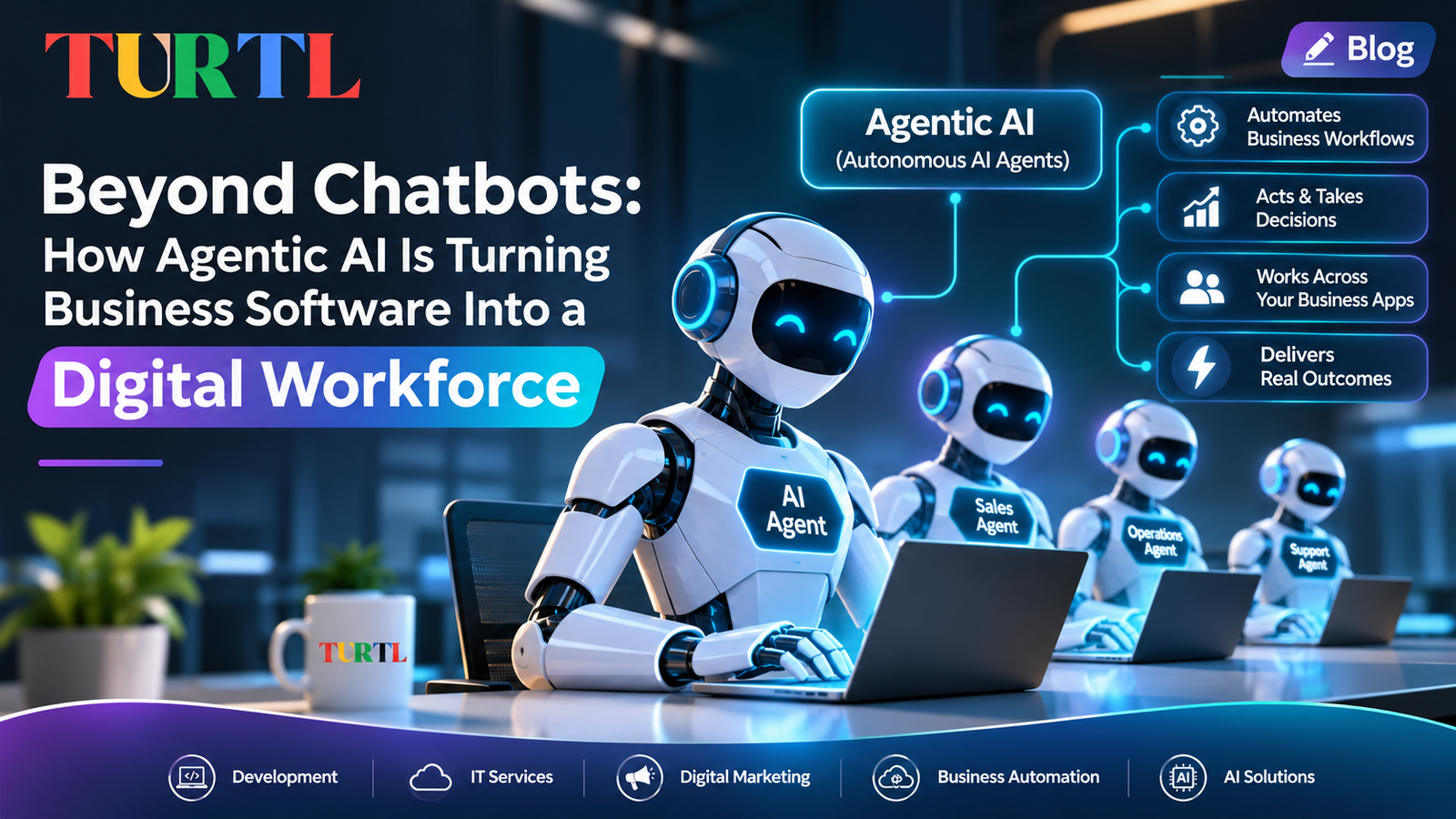
The next generation of business software will do more than store information. It will help businesses get work done.
For years, organizations have invested in digital tools to improve productivity. Customer relationship management (CRM) systems manage customer data, enterprise software organizes operations, and chatbots answer frequently asked questions.
But an important challenge remains: employees often spend hours moving information between these systems, completing repetitive tasks and following up on routine activities.
What if business software could coordinate some of these processes automatically?
This is the promise of agentic artificial intelligence, an emerging approach that enables AI-powered systems to plan tasks, interact with software tools and complete defined workflows within established rules.
In 2026, the conversation is shifting from AI that simply answers questions to AI that can assist with executing business processes.
What Is Agentic AI?
Agentic AI refers to artificial intelligence systems designed to pursue specific goals through a series of actions.
Unlike conventional chatbots that primarily respond to user prompts, agentic systems can coordinate multiple steps, use connected tools and respond to changing information.
For example, instead of only answering a question about a pending customer order, an AI agent connected to authorized business systems might:
- Retrieve the current order status from the database.
- Check inventory and dispatch information.
- Identify whether the delivery is delayed.
- Prepare a customer update.
- Send the update within approved rules or request human approval.
- Record the communication in the CRM.
The result is a connected workflow rather than a standalone conversation.
Importantly, agentic AI is not unrestricted automation. Reliable systems require permissions, operational boundaries, monitoring and human oversight.
Chatbots vs. Agentic AI: What's the Difference?
Traditional chatbots are primarily conversational tools. They provide information based on available knowledge, prompts and integrations.
Agentic AI goes further by coordinating actions across business processes.
A chatbot might explain how to generate a sales report. An appropriately configured AI agent might collect authorized sales data, generate a draft report, highlight unusual changes and send it to a manager for review.
A chatbot might answer a customer's question about a refund policy. An agentic workflow might check eligibility, prepare the refund request and route the decision to the appropriate team.
The key difference is the ability to connect reasoning with controlled action.
Five Ways Agentic AI Can Transform Business Operations
1. Intelligent Customer Support
Customer support teams regularly handle repetitive requests involving order updates, account questions, service appointments and technical issues.
Agentic AI can help categorize incoming requests, collect relevant account information and coordinate the next action.
When an issue requires judgment, the system can escalate it to a human representative with the relevant context already prepared.
This can reduce administrative work and help customers receive more consistent service, provided that escalation procedures and data access controls are properly designed.
2. Automated Sales and CRM Workflows
Sales teams often spend valuable time updating customer records, scheduling follow-ups and preparing meeting summaries.
Connected AI agents can assist by:
- Identifying leads that require follow-up.
- Preparing personalized email drafts using approved information.
- Summarizing customer interactions.
- Updating CRM records after verification.
- Flagging incomplete opportunities or stalled deals.
Rather than replacing relationship-building, this approach helps sales professionals spend more time speaking with customers and less time on routine administration.
3. Smarter Human Resource Operations
Employee onboarding requires coordination between HR, IT, finance and departmental managers.
An AI-powered workflow can help organize onboarding checklists, initiate approved account requests, track documentation and notify responsible employees about outstanding tasks.
Sensitive decisions, such as hiring outcomes, compensation and employment eligibility, should remain subject to appropriate human review and organizational controls.
4. Finance and Invoice Processing
Finance departments process invoices, purchase orders, approvals and expense records.
AI agents can assist with document classification, extracting information, checking for missing fields and comparing invoices with authorized purchase orders.
Exceptions, unusual transactions and payment approvals can then be directed to human decision-makers.
The objective is to improve processing consistency without allowing an automated system unrestricted financial authority.
5. IT Operations and Internal Support
Agentic AI can also support technical teams.
For example, an internal IT agent may examine an alert, retrieve relevant troubleshooting information, create a support ticket and suggest an appropriate resolution.
For low-risk activities, a team may approve limited automated actions. High-impact changes to production infrastructure should require stronger approval and rollback controls.
How Agentic AI Works Inside Business Software
A practical agentic system generally involves several connected components.
- The AI model interprets requests and helps determine appropriate steps.
- The orchestration layer controls how tasks are sequenced and which tools may be used.
- Business integrations connect the agent with authorized systems such as CRM software, ERP platforms, databases and communication tools.
- A permissions framework determines what information the agent can access and which actions it can perform.
- Monitoring and audit logs help teams understand what happened, investigate errors and improve the system.
- Human approval mechanisms ensure that sensitive decisions are reviewed before execution.
These components turn an AI experiment into a more manageable business application.
Why Custom Software Development Matters
Many businesses already operate several applications, each serving a different department.
Implementing agentic AI successfully requires more than installing an AI chatbot. Businesses need to understand how data moves between systems, where decisions are made and which activities can be safely automated.
Custom software development can help organizations build the APIs, integrations, administrative controls and dashboards needed for these workflows.
Consider a distribution company using separate systems for sales, inventory and customer support.
A carefully designed AI workflow could connect those applications, highlight order inconsistencies and prepare follow-up actions. Employees would retain control over exceptions and commercial decisions.
The value comes from connecting technology to a clearly defined operational problem.
The Risks Businesses Must Address
Although agentic AI creates new possibilities, companies should evaluate several risks before deployment.
- Data privacy: Agents should only access information required for their assigned tasks.
- Incorrect actions: AI-generated decisions and tool calls can be wrong, even when the language appears convincing.
- Security: Connected systems require authentication, least-privilege access and protection against malicious instructions.
- Accountability: Organizations need clear ownership of each automated process.
- Operational reliability: Failed tasks should be detected, logged and recoverable.
A responsible implementation should combine technical safeguards, testing, human approvals and regular performance reviews.
How to Start Implementing Agentic AI
Businesses do not need to automate an entire organization at once. A more practical approach is to begin with a specific workflow.
- Step 1: Identify repetitive activities. Look for tasks involving multiple systems, structured information and clearly defined outcomes.
- Step 2: Evaluate business value. Estimate the time, expense and error rates associated with the existing process.
- Step 3: Prepare the data and integrations. Make sure the agent can access accurate, authorized information.
- Step 4: Build a controlled pilot. Start with a limited set of actions and review the outputs.
- Step 5: Measure performance. Track completion time, accuracy, escalation rates, cost per task and user satisfaction.
- Step 6: Expand carefully. Introduce additional automation only after the initial workflow demonstrates reliable results.
Is Agentic AI the Future of Business Software?
Agentic AI represents a significant direction in software development because it connects analysis with action.
However, the most useful business systems will not simply maximize autonomy. They will balance automation with transparency, security and human decision-making.
Companies that evaluate AI through measurable use cases, strong architecture and responsible controls will be better positioned to identify where it delivers genuine value.
The goal is not to replace every employee with a digital worker. It is to give teams better tools for completing work efficiently.
Frequently Asked Questions
What is agentic AI in simple terms?
Agentic AI is technology that can plan and coordinate multiple actions toward a goal using connected software tools, subject to defined permissions and controls.
Can agentic AI integrate with existing business software?
Yes. Integration may be possible through APIs, databases, workflow platforms and other approved interfaces. Compatibility depends on the existing systems and their security requirements.
Is agentic AI suitable for small businesses?
Potentially. Small businesses can begin with limited use cases such as support ticket triage, reporting or administrative workflow assistance.
Will agentic AI replace human employees?
It may automate some tasks, but deployment still requires people to supervise operations, handle exceptions and make important decisions.
How can a company measure agentic AI ROI?
Useful metrics include time saved, workflow completion rate, manual correction effort, operating costs and customer experience.
Build Smarter Business Software with TurtlTech
The next stage of digital transformation is about making software more connected, intelligent and useful.
At TurtlTech, we help businesses design and develop custom software, integrate existing applications and modernize digital workflows.
Whether you are exploring AI-enabled automation or planning a new enterprise application, a strong software foundation is essential.
Ready to explore intelligent business automation?
Connect with TurtlTech to discuss your software requirements and identify opportunities to build more efficient business systems.
- Website: https://turtltech.com
- Contact: info@turtltech.com
- Call: +91 9958040595