

Business · November 22, 2024
AI App Development in 2026: How AI Agents Are Changing Mobile Apps for Businesses
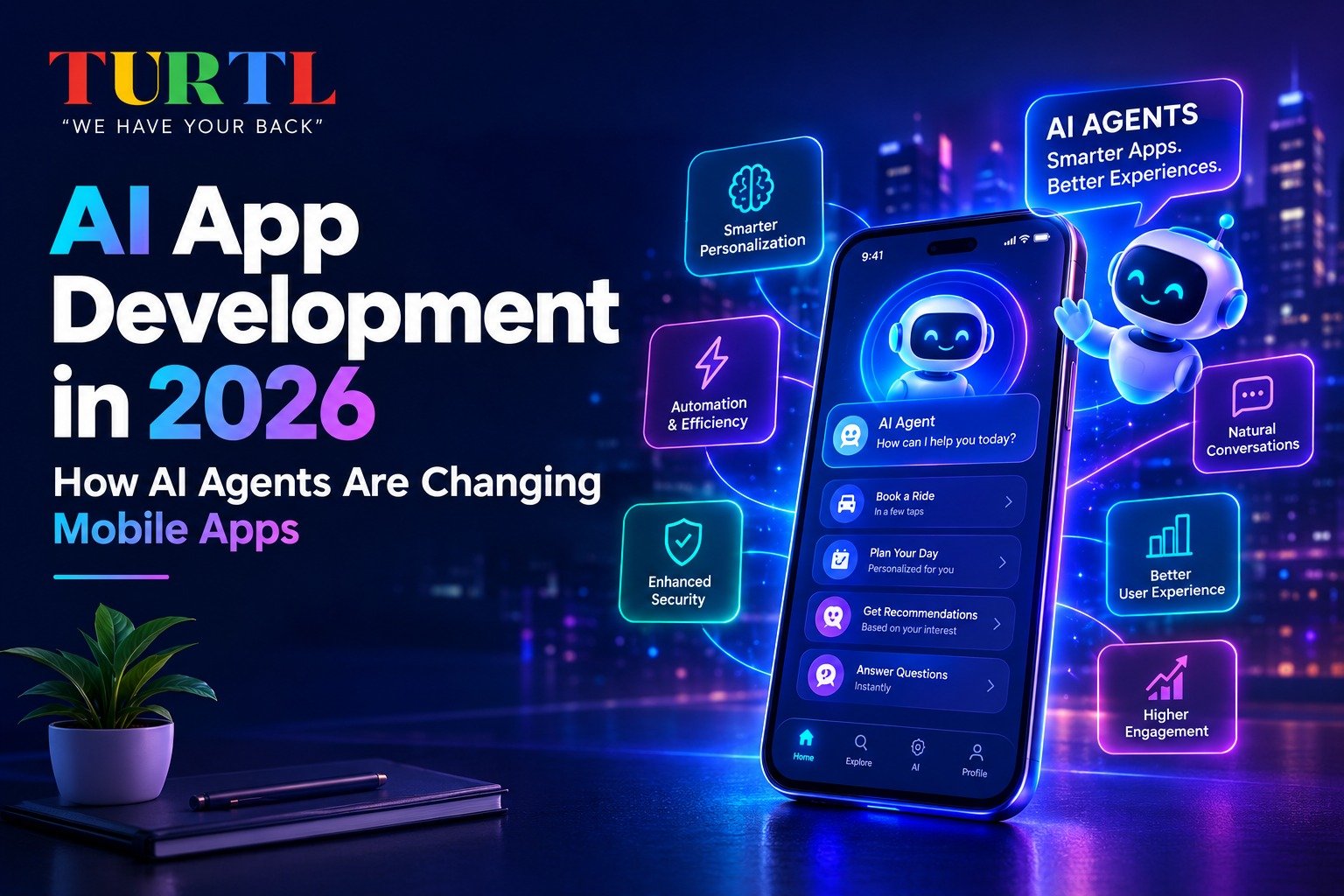
Mobile apps are no longer just about screens, buttons, forms, and notifications.
In 2026, businesses are looking at applications that can understand natural-language requests, personalize experiences, automate repetitive work, analyze information, and help users complete tasks more efficiently.
One of the biggest changes behind this shift is the growing use of AI agents.
A traditional mobile app usually waits for the user to perform each step. An AI-enabled application can provide intelligent assistance, understand context, work with approved business data, and in some cases help complete multiple steps within a defined workflow.
This is creating new opportunities for businesses across e-commerce, healthcare, education, real estate, logistics, SaaS, retail, finance, and professional services.
But there is an important question businesses should ask before starting: Does the application actually need AI?
The answer should come from the business problem, not from the technology trend.
This guide explains AI app development in 2026, how AI agents are changing mobile applications, which AI features businesses can use, how an AI app is developed, what affects its cost, how security should be handled, and how to choose the right development partner.
What Is AI App Development?
AI app development is the process of building a mobile or web application that uses artificial intelligence to perform tasks such as understanding information, generating responses, making recommendations, analyzing data, automating workflows, or assisting users.
AI can be integrated into an application in different ways. For example, a business application could use AI for customer support, intelligent search, recommendations, document processing, voice interaction, predictive insights, or task automation.
The important thing is that AI should solve a real problem. Adding an AI chatbot simply because competitors have one does not automatically make an application better. A useful AI feature should make something easier, faster, more relevant, or more efficient for the user.
How Does AI App Development Work?
A typical AI-powered application may combine:
- Mobile application interface
- Backend services
- Database
- APIs
- AI models or AI services
- Authentication
- Business rules
- Third-party integrations
- Security controls
- Analytics and monitoring
AI generally works as one part of the overall software architecture. For example, an e-commerce application can use AI for product recommendations while continuing to use conventional systems for payments, inventory, orders, accounts, and delivery tracking.
This is why successful AI mobile app development requires more than simply connecting an AI API. The complete product still needs good UX, reliable architecture, security, testing, and a clear business purpose.
How Are AI Agents Changing Mobile Apps in 2026?
AI agents are changing the way users can interact with applications.
Traditional applications usually require users to navigate menus, enter information, select options, and complete individual actions. An AI agent can be designed to understand a defined goal and assist with multiple steps using approved tools, information, APIs, or application functions.
For example, imagine a sales manager using a business application
and asking:
"Show me our highest-value customers who have not interacted with us recently and prepare a follow-up
list."
Instead of manually opening reports, applying filters, checking customer activity, and preparing a list, an appropriately designed AI workflow could help organize this information and prepare the requested result.
The exact capabilities depend on the application's architecture, available data, permissions, and business rules. The major change is that the interaction becomes more task-oriented.
AI Agents vs Traditional Chatbots
A traditional chatbot is mainly designed to communicate with users and answer questions. An AI agent can be designed to go further by working toward a defined objective and interacting with approved tools or workflows.
| Traditional Chatbot | AI Agent |
|---|---|
| Primarily answers questions | Can work toward a defined goal |
| Focuses on conversation | Can support multi-step workflows |
| Usually provides information | Can assist with actions |
| Limited tool access | Can connect with approved tools |
| Mostly reactive | More task-oriented |
However, an AI agent is not automatically the right solution for every application. If a business only needs a simple FAQ assistant, a chatbot may be more practical. If the application involves multiple connected steps, an agent-based workflow may provide greater value. The technology should follow the requirement.
Why Are Businesses Investing in AI-Powered Mobile Apps?
Businesses are exploring AI-powered mobile apps because users increasingly expect digital experiences to be faster, easier, and more personalized.
1. Better Customer Experiences
Users do not always want to navigate through multiple screens to find an answer. An AI assistant can help users find information or complete certain tasks using natural-language interaction. For example, instead of browsing several product categories, a customer could describe what they need and receive relevant suggestions.
2. Automation of Repetitive Work
Many organizations still spend significant time on repetitive tasks. Depending on the workflow, AI can assist with:
- Customer enquiries
- Lead qualification
- Document processing
- Report summaries
- Data classification
- Internal knowledge searches
- Follow-up preparation
- Appointment assistance
- Content organization
3. Personalized User Experiences
Different users can have different needs even when they use the same application. AI can help personalize recommendations, search results, content, notifications, offers, customer assistance, and user journeys.
4. Intelligent Search
Traditional search often relies heavily on matching keywords. AI-powered search can understand the intent behind a request more naturally. For CRM, ERP, finance, logistics, and other business applications, intelligent search can make large amounts of information easier to access.
5. Faster Business Insights
AI can help users identify patterns in business data, such as which leads are likely to convert or where operational delays happen. AI should support decision-making rather than automatically making important decisions without suitable controls.
What AI Features Can Be Added to a Mobile App?
Not every application needs the same AI functionality. The right features depend on the business problem, users, data, budget, and technical requirements.
AI Chat Assistant
An AI assistant can answer questions, provide information, help users navigate the application, and support customer-service workflows.
AI-Powered Recommendations
Recommendation systems can suggest products, services, content, or actions based on relevant user information.
Voice-Based AI
Voice interaction can make applications easier to use when typing is inconvenient. Users could potentially search, provide information, navigate features, or request assistance using natural speech.
AI Document Processing
Businesses work with invoices, forms, receipts, contracts, applications, and reports every day. AI can assist with extracting, classifying, and organizing information from documents.
Intelligent Notifications
Instead of sending identical notifications to everyone, AI can help determine which information may be more relevant to particular users or situations.
AI Agents
AI agents can be designed around specific workflows. For example, a sales agent helps with lead qualification, or a customer-support agent identifies the next step for an issue.
How Can Businesses Use AI Mobile Apps?
- E-commerce: Product discovery, intelligent search, and personalized shopping.
- Real Estate: Property discovery, natural-language property search, and lead qualification.
- Healthcare: Administrative workflows, appointment support, and information retrieval (with professional oversight).
- Education: Personalized learning, student assistance, and progress insights.
- Logistics: Operational information, delivery communication, and workflow automation.
- SaaS & Business: CRM assistance, report summaries, internal search, and data analysis.
How to Build an AI-Powered Mobile App in 2026
Step 1: Define the Business Problem
Before choosing technology, identify what problem needs to be solved and where users experience friction.
Step 2: Choose the Right AI Capability
Depending on the requirement, choose the simplest effective solution, whether that's generative AI, intelligent search, or an AI agent.
Step 3: Design the User Experience
AI should feel like a useful part of the application. Users should understand what the AI can do and how to correct incorrect results.
Step 4: Select the Technology Stack
Select tools based on performance, scalability, security, development time, and budget.
Step 5: Connect AI With Relevant Business Data
Define what information AI can access, which actions require approval, and how data is protected.
Step 6: Test Before Launch
Testing should cover functionality, response quality, security, and unexpected inputs using realistic scenarios.
How Much Does AI App Development Cost in 2026?
There is no single fixed price for AI app development. Major cost factors include:
- Application Complexity: More screens and workflows increase scope.
- AI Features: Voice AI and AI agents have different technical requirements than simple chatbots.
- Integrations: Connecting CRMs, ERPs, and APIs adds effort.
- Security: Handling sensitive data requires advanced architecture.
- Maintenance: Ongoing infrastructure management and model updates.
Why Choose TurtlTech for AI and Mobile App Development?
TurtlTech is a technology company based in Noida, delivering secure, scalable, and business-focused digital solutions across Noida and Delhi NCR.
Our approach to mobile app development starts with understanding the business requirement before selecting the technology and features. For businesses exploring AI, the objective is not to add artificial intelligence everywhere. The objective is to identify where AI can genuinely improve the customer experience, automate repetitive work, simplify access to information, or support important business workflows.
TurtlTech provides solutions across mobile applications, custom software, website development, cybersecurity, cloud solutions, IT consulting, and digital transformation.
Frequently Asked Questions
What is an AI agent in a mobile app?
An AI agent is a software system designed to understand a defined goal and assist with multiple tasks using approved tools, information, APIs, or application functions.
Can AI build a complete mobile app?
AI can assist developers with coding and prototyping. However, production applications still require human expertise in product planning, architecture, UX, security, testing, and maintenance.
Is AI necessary for every mobile app?
No. AI should be used when it provides meaningful value. A simple application does not automatically become better just by adding AI.
Final Thoughts
AI is changing what businesses and users expect from mobile applications. The next generation of apps will increasingly focus on helping users accomplish tasks faster and making business workflows more efficient.
If you are planning a new AI-powered product, upgrading an existing application, or exploring custom mobile app development, the right combination of strategy, UX, technology, security, and continuous improvement can turn an idea into a practical business solution.